Webinar Report: FinTech & Startups in Bangladesh: Building Resilience in Pandemic (2021)
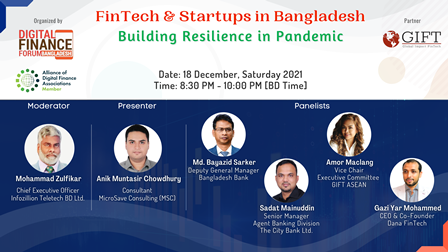
The Digital Finance Forum Bangladesh and GIFT Forum jointly organized a webinar session, titled ‘FinTech & Startups in Bangladesh Building Resilience in Pandemic’. The purpose for organizing different DFS related sessions for capacity building of professionals and policy advocacy. This sort of session is helping us to build the relevant knowledge and relevant capacity across the industry.
At first, Anik Muntasir Chowdhury, the presenter of the webinar started the session by introducing himself and also gave a short introduction regarding the topic of ‘FinTech & Startups in Bangladesh Building Resilience in Pandemic.’ He talked about the impact of the COVID 19 pandemic on the FinTech ecosystem of Bangladesh and he also mentioned, since March 2020, the COVID 19 pandemic has severely impacted our country's overall businesses. We have had lock downs, and also the fear of subsequent lock downs, extended periods of restrictions on movement, which led to a lot of anxiety about losses in business, and also shortened runways. For many small enterprises, startups, and fintech startups are no different in this regard.
Primarily he noted, “If I may just give a bit background, the report draw insights from our discussions with a mix of fintech different situation.” After discussion to several fintechs, some of them were very early stage, we spoke to some growth stage fintechs that you may all have heard of, and also some of the more mature ones, which are fintechs in their own rights, but maybe a bit bigger than the regular startups that we conceive of.
As the privilege to speak with representative from Bangladesh Bank, having analyzed data from Bangladesh Bank, as well as from other credible public sources industry reports. In this report, mainly have some findings of what actually happened all about the fintech industry. How the ecosystem emulator or regulators have supported them? And what is next, what is the extent of support required? How can fintechs remain resilient and grow in this rapidly evolving world filled by technology without being vulnerable by the systemic changing in our business environment?
Let's first look at how the COVID-19 impacted in fintech. Being increased digital payments, right now COVID-19 had a polarizing impact on fintechs. So we're talking about the effect of digital payments, because those in the payments based flourished more than the others. Actually, the digital payments increase during the pandemic. At February 2020, it was USD 11.8 billion. And at June 2021, it rose by 76% to $20.85 billion. If you see the Bangladesh Bank data for digital payments for cards, EFT, internet banking, mobile financial service, agent banking, then we can actually see that the trends are continuing. Mobile financial service that peaked particularly during the early months of the pandemic until September 2020. For example, the personal retail accounts for micro merchants to accept digital payments, and also Bangla QR or QR based payments that transform physical retail points to digital touch points.
Digital payments and online sales are still remaining high. So we've realized that fintechs need to take a fresh look and also approaches to recover and grow. They need to understand the importance of both resilience and relevance for that we have some specific points. Now, while the government and the regulator, particularly Bangladesh Bank, have done a great deal for fostering innovation among startups, which is well acknowledged, the industry believes there is still a lot of potential to do further kind of work. So Bangladesh Bank has already been very pro innovation and proactive and it can continue to be in that way.
After this long discussion, the moderator called the first panelist Mr. Sadat Mainuddin, Senior Manager (Agent Banking Division) in The City Bank Ltd. and he is also a founding member of the DFFB, to narrate his experiences by highlighting his banking sector as a stakeholder in the ecosystem and the impact that banks suffer due to this pandemic. Again he started by mentioning the COVID-19 pandemic situation that was affected the banks great extent, the overall in the volume of Non-Performing Loans (NPLs) grew by more than 7% to TK. 950.85 billion during the January to March period of 2021. Despite providing policy support by the central bank in relation to loan classification, the Bangladesh Bank also predicted that weaker asset quality due to higher level of performing or non-performing loans and poor profitability condition may partner within the banking sector properly in the coming quarters. They have seen that there exists including the banking sector, which has nearly doubled from 1.2 to 3 trillion in January 2020 to 2.05 trillion in December 2020. Due to low investment in overall economy, private sector trade goods decrease also significant digit 8.1% in April 2021 on a year basis.
The bank is also working with the World Bank to introduce a partial credit guarantee scheme with an initial USD 300 million to share some of the potential losses with the impacted banks and this will support early stage fintech to have the credit guarantee scheme to enjoy a quarter fee loss which will be provided to commercial banks also. The current banks as a stakeholder in the ecosystem, banks are doing pretty much well contribution in conjunction with fintech industries in Bangladesh. The banks are currently working to establish an interoperable digital payment platform as per the guidance of BB, the interpretive operability will work within banks in MFS and PSPs. Also several of the banks are working on the Personal Retail Account (PRA) to increase a number of small merchants, although bKash is well ahead regarding this issue. In conclusion, he would like to say that an integral part of the country's economy banks is the most important part in the overall startup ecosystem. Banks are receiving very good guidance from Bangladesh Bank. However, we should remember that startup ecosystem is ever changing and good balancing. Bangladesh Bank as well as commercial banks should change according to need within a very short time.
Then the moderator introduced the next panelist Mr. Md. Bayazid Sarker, Deputy General Manager of Bangladesh Bank, and the moderator said, “Excluding all discussion about the regulations, I would be happy to listen to some portion of the regulatory perspective which has given the resilience in this situation.” He said that the regulation has already covered but he would like to touch couple of things that Central Bank already declared about the regulations that they have also issued that is interoperability start-up and regulations that already discussed about the Bangla QR code that is also in fintech areas and another important thing as a central bank has to the fintech industries to involved in the cash distributions. Especially the government wanted to distributed up their cash incentive or Cash allowance to the 5 million distinct people over the country. The central Bank of Bangladesh and the government together are able to involve all the fintech industries in Bangladesh and the remarkable things to come forward and more attached with digital finance. In the fintech industry we have put our resilience but at the same time as our economy also proved their experiences with a good resilient because before the pandemic our growth rate was much higher 8% to 8.2 % and during the pandemic it comes down to 3.5 %. When we reach the new normal of 5.5 % and hopefully post-pandemic period that means coming 2022, the first fiscal year, we will be able to achieve our growth at 7.2%.
Next the moderator requested another panelist Ms. Amor Maclang who is the Vice Chair-Executive Committee, GIFT ASEAN. Additionally, with the introduction the moderator asked the panelist if she had any points regarding the effects of fintechs during the pandemic in globally. Philippines has been a member in the last fintech festival in 2020, be announced that they had reach a 1 trillion more into different actions and less than one year after in November, 2021. They have now declared in the Philippines first. Now this progress is not without its best. Philippines has had one of the biggest challenge for cybersecurity. Financial Institutions was under cyber-attack and right now there are risks and that have been more pronounced. What happened was the redirection of certain funds from a legacy bank to a hybrid legacy and digital bank which is directed through a crypto exchange. So this is a challenge for a given the fact that the Philippines has recently been placed in the 2021 as a team list for cybercrimes. The instructions for as a whole of nation and a whole society approach towards cybercrimes in other words an attack on one institution is not a covid-19 situation but actually at the country are even more pronounced in the challenge is not just to create a cyber-environment for organizations but rather for activity. They look forward to forever cooperating with the fintech association here in Bangladesh and on behalf of the Global Impact for fintech at the largest plane tank.
At last the rest panelist Mr. Zia Hassan Siddique, CEO & Co-Founder of Dana FinTech, added some important issues over the current fintech status. Actually, fintechs and banks are try to combine with the new technologies and also try to adopt for ensuring different API applications and digital transactions. So, banks and fintechs are now playing very initiative and innovative role in the field of digital banking or credit system. Mainly from the fintech background and as a fintech player of the market, they hope some proper regulations from Bangladesh Bank or any Govt. regulatory board for doing the fintech business flawlessly. Also mentioned the collaboration of bKash and City Bank is a new direction for the digital banking system with the application of technology.
In near future, we will see a major boom in the overall transaction fintech Financial Technology and everything so we are looking forward to that and I think new ideas will come into play once this interoperable transaction in our market.
After ending the presentation, there was a Q/A part:
“How did conventional financial organizations like banks actually deciding right now during covid-19?” Mr. Sadat replied that the best to do is equity based customer onboarding and every time the bank needs to develop the digital onboarding system within the banking business ecosystem. Banks are providing services by their own QR based internet banking app in the market to facilitate which also help and support a large number of customers during this situation as well as they have supported the businesses during the second wave of pandemic. There were many more questions from the audience and open discussions.
Impact:
The COVID-19 pandemic had a pronounced effect on FinTechs as well as startups in Bangladesh. Mainly the findings of concern including the emerging vulnerabilities for the startups with lower endowment and poor access to government stimulus packages and other financial support. However, the absolute amount of profit was substantially lower for both startups and fintechs, compared to their pre-COVID profit, indicating the importance of scaling up such intensive training to create more resilient enterprises in such crises.
|