Webinar Report: Regulating Digital Credit for CMSME & Personal Finance (2021)
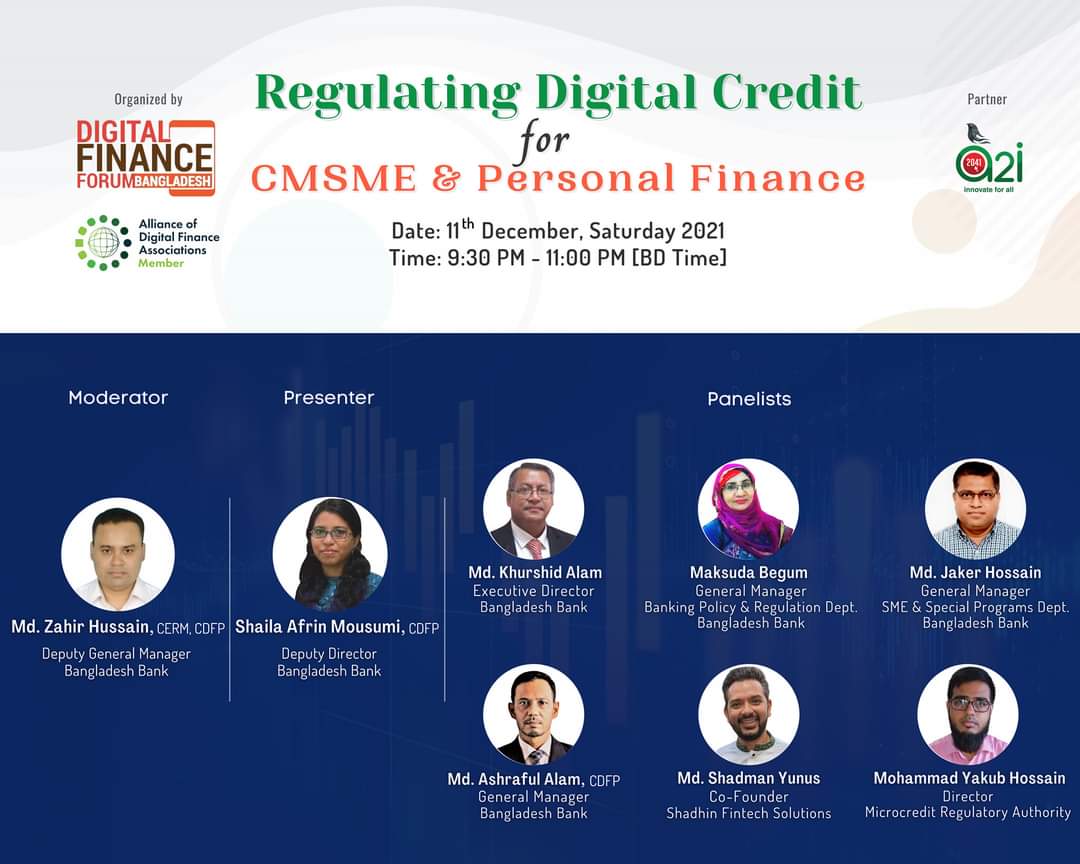
A webinar session titled ‘Regulating Digital Credit for CMSME & Personal Finance’ was organized jointly by the Digital Finance Forum Bangladesh and Access to Information (a2i) Programme under ICT Division, Government of Bangladesh.
At first, Mohammad Zahir Hussain, the Moderator of the webinar introduced himself and gave a short introduction regarding the topic of discussion. He stated that the need for digital credit has increased specially during the COVID pandemic situation due to its three special characteristics: instant, automated, and remote. But, the banks are usually interested more to deal with the corporate loans as these loans has been covered by the physical collaterals as well as corporate guarantees. The monitoring cost of the corporate loan is not high as the products have some of the corporate occupied significant market shares and has good reputation over the market. The bank cannot also worry about the recovery of their corporate loan because you know that they are deal with corporate loans and their profitability is much higher than other banks. Therefore, the journey of the Digital Credit is not yet flourished in Bangladesh.
The banks are not accustomed to digital credit. Some of the banks has started but in a very small scale. In our country, we have seen some FinTech Startup companies are expanding digital credit but the regulation of digital credit in terms of KYC, documentation, credit rating, collaterals, and interest rate are not clear and they are not under the purview of Banking Company Act, 1991 for conducting their small ticket credit operations. So, there is a debate here- is it regulated or unregulated? As a result, the market of digital credit is limited. At this stage, formulation of proper regulation could only uplift the flow of digital credit and helps in extending financial inclusion to the doorsteps of marginal and poor people at an affordable cost in future.
Then the moderator introduced the presenter Ms. Shaila Afrin Mousumi, Deputy Director of Bangladesh Bank, and invited her to present the keynote paper. At the very beginning, the presenter explained digital credit with a great and relatable example of emergency credit on cell phone. She also added that in credit application, assessment, disbursement, repayment and recovery – all the steps are done using digital technology. She also mentioned M-Shwari in Kenya launched in 2012; M-Pawa in Tanzania, and Kubo in Mexico; Suvidhaa and Axis Bank in India have started digital credit.
Digital Credit Process:
• Customer interactions and credit processes are handled remotely or automatically, including loan applications, approvals, repayments and collections.
• Digital credit use conventional credit scoring information as well as a range of alternative data sources, such as payment information, transactions, e-commerce and other data to determine credit eligibility and pricing.
Digital Credit Drawbacks:
• Digital credit focused on instant, automated and remote.
• That is why large enterprises are overlooked in digital credit service. For large loan, credit guarantee, huge documentation, collaterals etc. are required.
Present Situation in Bangladesh:
• About half of the adult population of the Bangladesh is unbanked. There is a 14% gender gap in MFS account ownership, 29.2% in ban account ownership.
• Only 28% of CMSMEs have access to finance whereas 44% large enterprises have the access to finance.
• Disburse volume of credit to CMSME to total credit is much lower. CMSMEs sector represents 13 million business entities with 35.5% of total employment and contributes 25% of country’s GDP.
• Random selection of the quarterly (October’2020- December’2020) statement of CMSMEs credit disbursement, it has been seen that 92% are male and remain 8% are female entrepreneurs.
Need for Credit:
• Most of the entrepreneurs are facing challenges in fulfilling all requirements of banks and 59% CMSMEs find loan disbursement process complex.
• The government announced stimulus package worth TK 1.4 trillion-which is approximately 5.0% of Bangladesh’s GDP. Some TK 200 billion has been allocated for the CMSMEs since the package was announced in April 2020.
Then, the presenter also discussed about the problems related digital credit, consequence, challenges, Related Laws, an example of Digital Lender (Rapidcash), and so on.
Then the moderator introduced the first panelist Mr. Md. Ashraful Alam, CDFP and wanted to know, “Do you explain the use case of digital credit in Bangladesh? And also share some country experiences where the digital credit successfully operated.”
The Mr. Md. Ashraful Alam discussed the experience and explained about the digital credit or instant credit. He also mentioned that worldwide insta-credit is knows as digital credit. Actually, he talked about some various topics such as illegal and fraudulence recent activities of few FinTech company in Bangladesh as well as lacking of proper regulations or regulatory board for regulating the digital credit and FinTech companies in Bangladesh. So, he finally proposed to sit together regulators and come up with a comprehensive regulations that will basically provide clear guidelines to the intended operators- it can be FinTech, microfinance institution, financial service providers (Banks or MFI’s), etc.
Then the moderator requested next panelist Mr. Md. Shadman Yunus, Co-Founder of Shadhin Fintech Solution. The moderator asked the panelist if he had any points regarding lending services by the Fintech in Bangladesh. Mentioning Shadhin Fintech Solution as a marketplace to connect the borrowers and investors i.e. institutional investors, financial investors, individuals, they are providing financial technology services. At the very beginning, he remarked ‘credit’ is a basic human rights and a large portion are middle class to lower income Bangladeshi’s, especially in the urban cities are not necessarily getting access to credit at this point. He also mentioned that there are so many Fintech solution or service providers on the market in our country and it is the indication of the opportunity for doing business in this market. He explained about the three different Fintech lending landscapes – i. Tech Enabled/Marketplace Facilitation, ii. Direct Digital Lending, iii. Indirect Lending.
He felt that market is ready to absorb many Fintech players and the basic reason is the size of urban middle class people in a large portion. They may look for medical loans, student loans, loans for paying tuition fees, loans for running small businesses, salary gap, buying devices and so on. Finally, he ended with some positive directions and those are – good for ecosystem, increases tax income from the middle class family, increases financial inclusion, improves life style, etc.
Further, the moderator introduced Mr. Jaker Hossain, General Manager, SME & Special Programs Department of Bangladesh Bank, and asked if he thought CMSME’s are getting adequate financing from the formal financial institutions. He also added if he found any potential role of digital credit for CMSME’s financing. Will it have any contribution in COVID-19 stimulus package and quick recovery from the economic shock? The panelist highlighted some of the corrections and critiques of the previous discussion. Later, CMSMEs talked about the demand-side and supply-side in detail about whether they are getting adequate loan from the banks. Borrowers are demand-side and Bank/ NBFI are in supply-side. In this case, the banks are claiming that they are giving loans but the entrepreneurs are saying that they are not getting loans. There are several reasons for this miss-match. Such as lots of documentation, TIN certificate, proper accounting records, balance sheet, bank statements, etc. As a result, small entrepreneurs are not able to take loans from banks. So efforts should be made by the appropriate authorities to formulate the regulations for digital credit/small credit after judging the issues.
The moderator for giving his valuable opinion requested another panelist Mr. Mohammad Yakub Hossain, Director of Microcredit Regulatory Authority. Moderator asked “is there any regulations of MRA for providing small credit by MFI’s through digital platforms? Can Fintech companies obtain license of MRA to provide digital micro credit?” He added some corrections in the presentation in case of licensed MFI’s effective interest rate is about 23%. But, in case of illegal activities in micro financing there may be higher interest rate. He also mentioned about the Banking act, financial acts, and also other acts for regulating micro finance digitally. So, he thought, MRA allowed to accommodate in case of providing micro-finance to the unbanked people and if Fintech want to get license from MRA to become a MFI, then the organization can conduct operations.
Furthermore, the moderator introduced Mr. Md. Khurshid Alam, Executive Director of Bangladesh Bank, and requested him to put his valuable speech on if he agree that the digital credit might bring under formal channel? Do he suggest it legitimate operation through law or guidelines?” He replied in the affirmative and said that last two years in pandemic, we have seen that all are in a block situation. But our day to day life have been carrying on. So, there was no alternate way to use digital system, digital channels, even daily business sectors, banking sector, formal/informal sector all are depending on the digital channel. He also mentioned about the safety and security of digital lending system by the law enforcement.
The moderator again asked a question to the Mr. Md. Shadman Yunus and the question was, “What kind of policy support Fintech needed to flourish in Bangladesh?” He thought there are 5 things in the policy guidelines and these are: paid up capital, sources of fund, data protection, continual audit and tracking, and regulatory frameworks and supports.
Finally, there were also some specific questions to the panelists from the moderator side. Against of all those questions, there were some critics and thoughts from different panelist as per their perceptions. The panelist Ms. Maksuda Begum was not attended in the webinar because of her some emergency issues.
After ending the presentation, there was a Q/A part. One of the audience a question and it was, “Does the central bank have any mindset to give the license of account aggregation?” The convener of the DFFB answered the question. He replied in the negative and said that no one applied yet for central bank to approach for that service actually. Whenever any service would approach to the central bank, then the central bank will consider the application. But the central bank would not proactively ask a market-player to apply as long as market is not ready and he also thought that the service provider has not approached till now for account aggregation but there is a merchant for aggregating service and Payment System Department already allowed for account aggregation.
Impact:
Bangladesh has come a long way in digitizing its financial sector amid the fast-moving world of Industry 4.0. With the inception of online banking, followed by mobile financial services (MFS), we stepped into a new era of finance powered by technology.
In Bangladesh, people are often compelled to take loans from informal sources at high interest rates and complex terms and conditions to meet emergency needs such as a medical crisis or financial loss caused by natural disasters or even engaging in a small trade. In many cases, due to high cost and onerous terms and conditions, unbanked people find it difficult to repay those loans and are over-burdened with even higher debt. So, right now many fin-tech companies are addressing these problems by introducing a digital loan platforms with simple repayment terms and conditions.
|