Webinar Report : UN Principles for Responsible Digital Payments (2022)
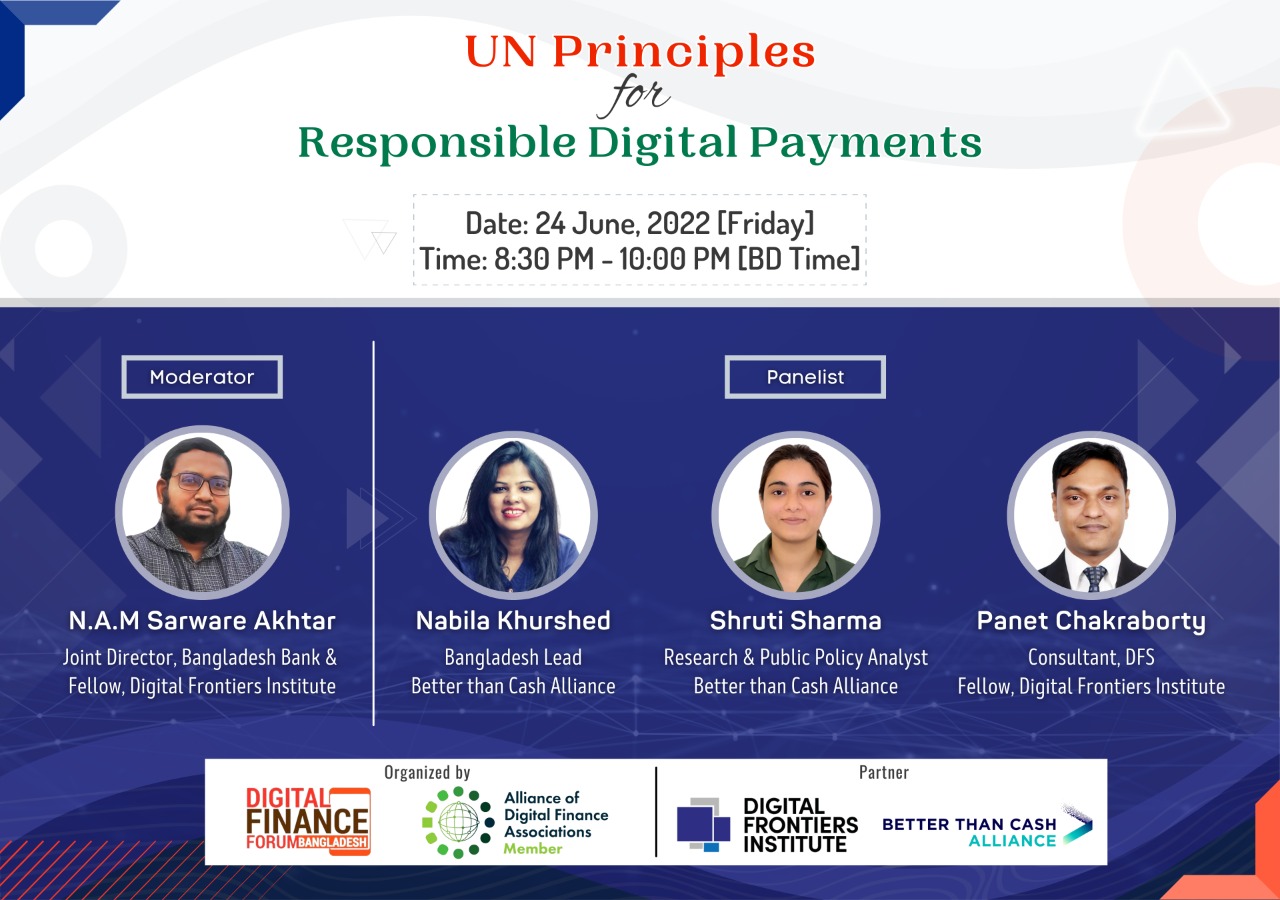
A webinar session titled ‘UN Principles for Responsible Digital Payments’ was organized jointly by Digital Finance Forum Bangladesh, a member of Alliance of Digital Finance Associations in partnership with Better than Cash Alliance and Digital Frontiers Institute. The purpose of Digital Finance Forum Bangladesh is to organize different DFS related sessions for capacity building of professionals and policy advocacy. This sort of session is helping us to build the relevant knowledge and relevant capacity across the industry.
At the very beginning of the webinar, Ms. Shruti Sharma, one of the panelists from Better than Cash Alliance (BTCA) shared her experience working in the digital payment space. “I would like to say that with Digital Payments proving foundational and building stronger from the pandemic”, she said. At the time of introduction of Better than Cash Alliance she stated that the Alliance is based at the United Nations Capital Development Fund which is a part of the broader umbrella of UNDP. There are 80 members and all are committed to transition from cash to digital payments. Along with other initiatives for Bangladesh, BTCA facilitated peer learning exchanges for a2i Programme DFS team members in Brazil and India.
The UN Principles for Responsible Digital Payments provide actionable insights to drive responsible digital payments which build trust and equity for all. Digital payments must be- work every time, be fair, be transparent, be accountable and offer recourse when they fail.
The nine principles are foundational to building better economies in the aftermath of the pandemic.
1) Treat users fairly
2) Ensure funds are protected and accessible
3) Prioritize women
4) Safeguard client data
5) Design for individuals
6) Be transparent, particularly on pricing
7) Provide user choice through interoperability
8) Make recourse clear, quick and responsive
9) Champion value chain accountability
Shruti Sharma explained about the Key Challenges, Recommendation for the challenges, and some Good Practice Examples of the first 3 principles from the above list. For the 1st principle (Treat users fairly), she mentioned about ‘Bangla QR Payments’ & ‘eKYC’ as the good practice examples. “Increase the scope of partnerships to maximize transparency of terms and conditions to users”, she said as a recommendation for the 2nd principle (Ensure funds are protected and accessible). To recognize the critical role of women in the next billion users and use partnership agreements to prioritize women-recommended for the 3rd principle.
Then another panelist Nabila Khurshed from Better than Cash Alliance continued the presentation. She also explained rest of the principle’s Key Challenges, Recommendation for the challenges, and some Good Practice Examples. ‘Personal Retail Accounts’ & ‘Digital Nano Loan’ are the best examples of 5th principles (Design for individuals).
Integrated Management Information System(Senegal), WFP’s blockchain-based cash transfers in Bangladesh, and Bangladesh Bank Complain Management App- all are the examples of 6th, 7th, and 8th principles respectively.
‘The intersection of payments value chains with members’ own supply chains is complex and from user’s perspective, it is difficult to identify who is responsible for offereing recourse'- are the key challenges and ‘International Rescue Committee’ is an example of 9th principle.
Finally, the moderator called Mr. Panet Chakraborty and also introduced him. First, he mentioned whenever we implement a system, it’s actually not a system in isolation, it’s a part of the eco-system. Also said, “Not only UN principles is responsible for digital payment, but also some other regulators or organizations.” Need to build up a trusted payment system with the proper regulations or principles as the view point of customers.
After ending the presentation, there was a Q/A part:
One of the audience asked to Panet Chakraborty what can we learn from the UN principles from the Bangladesh context and what is the impact you have seen in your experience or even principles for responsible digital payment. Mr. Panet replied that after pandemic as an eco-system of digital transition along with all sort of activities during the digital financial services need to modernize recourse and make it fair. In Bangladesh perspective, we have the baseline in Election Commission data and ICT division taken initiatives to formulate different digital security act and an integrated approach may help us to understand a holistic view and every organization being individual or being Payment Service Operator (PSO) can make a trustworthy market for responsible digital payments and we can take UN Principles as per Bangladesh context.
'The UN Principles for Responsible Digital Payments' have been developed as a guideline for governments, companies, international development organisations to adapt the most inclusive, responsible practises in scaling digital payment. The world is moving to digital payments because they are swifter, safer, and more transparent than cash. By digitizing payments responsibly, we can swiftly reach financial equality and advance the Sustainable Development Goals.
|